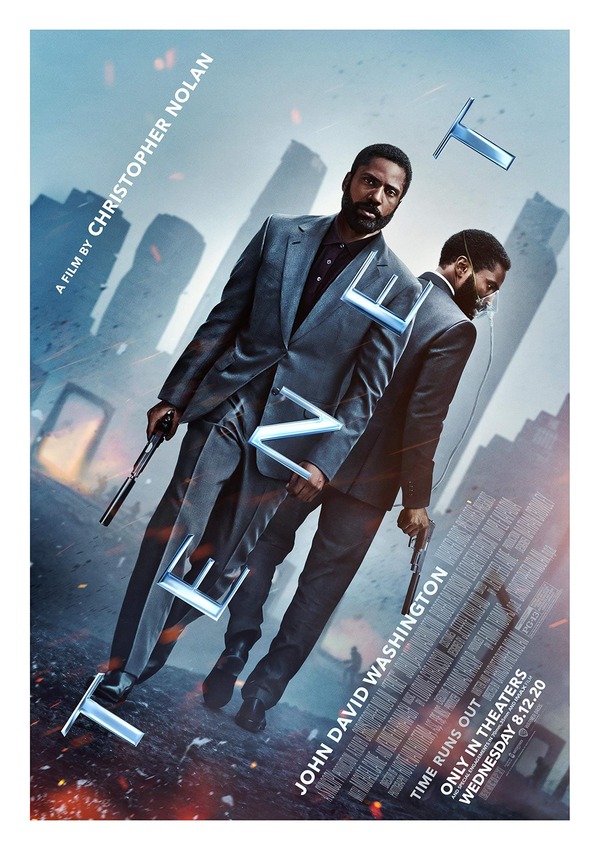
Tenet is a film that eludes you the moment you attempt to rationalize it. While it is now accessible via streaming platforms, hesitating to watch it due to its reputation for being “difficult” means forfeiting a rare opportunity for a purely sensory cinematic experience. The reason this film is perceived as difficult is that we attempt to understand the incomprehensible. There is no need to exert effort searching for evidence at a scene where no event has occurred. While one hunts for non-existent evidence—the object of interpretation—the treasure lying in plain sight remains undiscovered.
At some point, we began wasting time on such searches for evidence. We did not seek the scientific principles of time travel while watching Back to the Future, nor did we attempt to master the mechanisms of genetic cloning while viewing Jurassic Park. Time travel simply resolved the conflict, and the dinosaurs appearing before our eyes simply threatened us.
The same applies to Tenet. Whether it be a person or an object, that which is “inverted” flows backward through time. That is all we need to understand. Through the premise of “time inversion,” we experience a distortion of structure where the conclusion becomes the cause and the cause becomes the conclusion. This experience provides the audience with catharsis as the questions held toward a distorted reality are finally resolved.
This film halts when approached through explanation and functions only when accepted through the senses. We shall examine why there is no need to find Tenet difficult and how the sensations provided by the film operate.
Note: This analysis discusses specific narrative elements and structural details of the film.
A Film That Transmutes Even the Time to Comprehend into Sensation
The primary reason this film is viewed as difficult is that unfamiliar concepts are presented simultaneously within a rapid progression. However, the concepts explained within the film are merely an introduction to reveal its structure; there is no necessity to understand every detail. The only truly important factor is that time goes backward; the rest are merely functional devices used to maintain the momentum of the drama. For an audience demanding internal consistency, these are devices that elevate the work’s refinement, but for those seeking to experience the sensations the film offers, they are merely secondary explanations. Thus, the brief explanations act as a safety mechanism to prevent one from sinking into a swamp of complex theory.
The criticism that information density increases toward the latter half is valid. Sequences where different axes of time collide on a massive scale induce cognitive overload. Yet, paradoxically, the space where that overload rains down allows the audience to witness a physical marvel never before experienced. When we let go of the compulsion to understand every causal link, the film finally provides its original experience.
The film’s method of explaining further reinforces the idea that understanding is unnecessary. In the scene where the protagonist first passes through a turnstile and receives an explanation regarding inversion, he asks what happens if one touches their forward-moving self. The answer is simply: “Annihilation.” No long-winded exposition or description of the process of vanishing is required. Only the fact of annihilation upon contact matters. The same applies to the dialogue regarding the “Grandfather Paradox.” If it remains incomprehensible, one need only listen to the following line: “What’s happened, happened.” It means that even though one influences the past by reversing through time, even that is an event that has already occurred.
Even if this dialogue holds narrative clues or pertains to the relationships between characters, it is presented alongside the concept of the Grandfather Paradox; if there is insufficient time to comprehend it, one may boldly let it pass. By focusing on the overwhelming experience of the film, one finds themselves feeling greater satisfaction in the structural shock of the plot than in the narrative’s probability.
Sculpting Time: From Narrative to Action
Christopher Nolan is a director preeminent in designing the distortion of time as a structure. In particular, the method in Memento—showing the conclusion first and arranging preceding events in reverse chronological order—was an innovative attempt to demonstrate that a cause can become a conclusion.
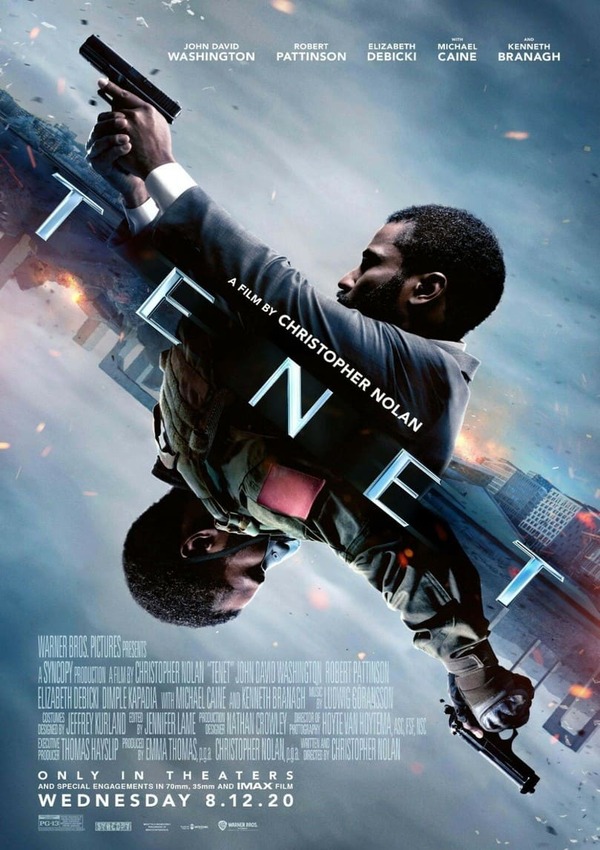
If Memento translated the reversal of time into narrative, the originality of Tenet lies in utilizing this reversal as a device for action. While watching the film, the answers to questions such as “Why is this happening?” or “Who is this person?” are found in the future rather than the past, providing cognitive liberation by dismantling the familiar logic that causes must reside in the past. The catharsis when the pieces of a seemingly impossible puzzle click into place—especially the shock when the manner in which the puzzle is solved is entirely unexpected—leaves one in awe of how creatively the visual medium of film can be utilized.
Action in this film is not about flashiness. In a situation that cannot be logically explained—where time is being overturned—Nolan shows the sequence directly instead of explaining the inherent logic. The audience “experiences” the unfamiliar sensation rather than understanding it. There is no need for the audience to know why time is flowing backward. They need only feel and experience the dynamic actions that occur as forward and backward time interlock. The thrill provided by this strange intersection of causality proves that film is not a mere tool for narrative, but a medium capable of sculpting and exhibiting time as a physical object.
The Naked Eye Over the Microscope
This effort to exclude narrative is also evident in the sound design. The dialogue is set low while sound effects are positioned loudly, which reads as a directorial declaration guiding the audience’s gaze toward seeing rather than hearing. However, this imbalance may feel more pronounced in an streaming environment where theatrical surround sound is compressed. If this imbalance is felt to hinder appreciation, one can actively manage the volume by utilizing the film’s structure, in which dialogue sequences and action sequences are largely separated. This is a proactive experience available only to streaming viewers, which was impossible in the theater.
Despite such inconveniences, the fact that it is difficult to find a film in recent cinema that provides this level of cinematic experience is sufficient reason to watch it. Choosing structural brilliance over visual flashiness, Tenet offers us a new sensation. For the audience exhausted by the task of searching for what the lead character signifies, this film exists—one in which the protagonist does not even have a name. If one is ready to view the film with the naked eye rather than a microscope, they will, in that moment, encounter the treasure Nolan has prepared: the pleasure provided by structural experience.