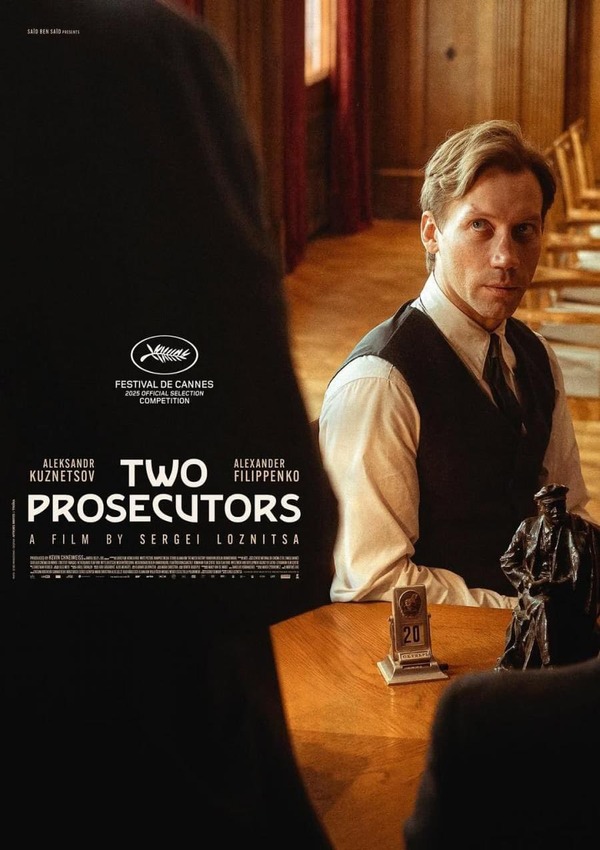
An invitation to the 78th Cannes Film Festival and high ratings from Screen Daily have ostensibly elevated this film to the status of a masterpiece. However, what was witnessed in Two Prosecutors was not cinematic achievement, but rather the reality of an illusion conjured by authority. It consisted entirely of conventional direction, a castrated narrative, a dragging pace, and repetitive explanations. The mise-en-scène lacked creativity, and the montage was vacuous. I was not watching a film, but a political thesis. Our time is too precious to place blind faith in a Cannes Film Festival that has devolved into a political symposium. I intend to coolly dissect whether there is any valid reason to view this film, stripping away the veneer of its perceived authority.
Vacuous Montage, Banal Mise-en-scène
The first 40 minutes of this film are consumed by the protagonist requesting an interview with a figure in prison and the subsequent realization of that meeting. The audience is forced to stare at empty spaces for this prolonged duration without being granted any premise or basis for imagery. In typical cinema, such restrained montage provides the latitude for the expansion of thought and indulgence in imagery. In this film, however, one was forced to impatiently urge the plot forward while traversing those voids. The audience sat in the theater holding brushes, ready to color freely, but the film provided the time to paint without providing any pigments. The audience experience—of mixing colors and applying them to various sections—was displaced by a destitute ordeal of having to demand something from the film’s hollow direction.
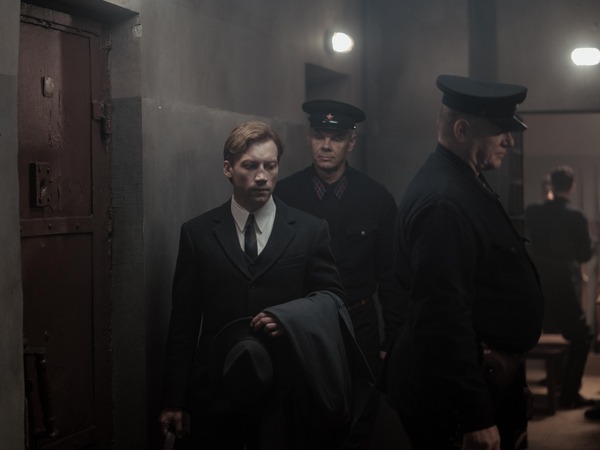
The mise-en-scène of the prison illuminating those intervals offered no assistance. While green hues were utilized, they were too meager to instill any particular imagery, and the prison interior forming a mise-en-scène that reveals a cold reality was excessively textbook. The prologue—a flat angle of a building under construction—gave the impression of a plausible shot inserted randomly, especially considering such angles never reappear.
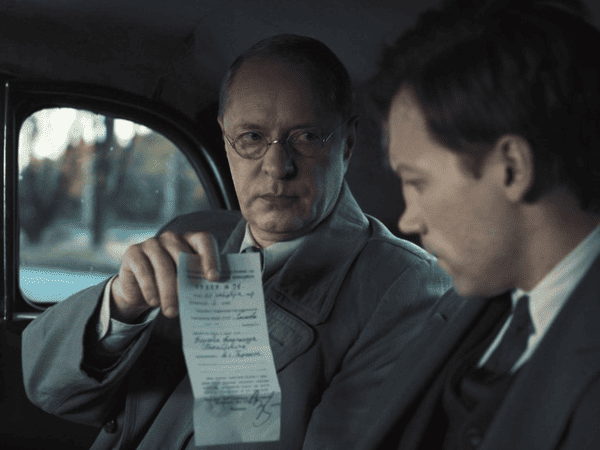
It was a miscalculation to expect mise-en-scène in a film that explains everything through dialogue. This film explains its entire content through conversation, and even those explanations are frequently insufficient or tedious. The scene encountered after 40 minutes of tedious waiting was a 20-minute sermon. The dialogue in the prison was a continuous stream of lines with no end in sight, inducing an identity crisis in the audience; it was unclear whether one had come to watch a movie or listen to a radio broadcast reading a history book. At the very least, that scene contained substance. In contrast, the scenes inside the train to Moscow consisted of a mere list of empty modifiers. While it seemed intended as a meta-device to display the boredom of peripheral characters, the mise-en-scène and montage conveyed nothing, leaving the audience with a physical fatigue that triggered an urge to escape the screen.
Given that the source material for this film is a novel, one can infer that these scenes may have functioned meaningfully in literary form. In a novel, the reader can maintain tension by adjusting their own pace—immersing themselves in important sections while speed-reading less critical ones to conserve energy. Film is different. The director must perform this regulation of rhythm directly, for the director’s duty is to show. In that sense, the film failed to show.
Flat Characters Proving Narrative Deficiency
Even when the audience attempts to exercise an active will to watch, they are rendered helpless before the film’s negligent design. It is impossible to discern what ideology the protagonist held before encountering various events. This creates confusion as to whether the protagonist’s ideology is deepening or being subverted through subsequent incidents. This lack of a character arc leads to a deficiency in the character’s three-dimensionality. The character is depicted too simply for the audience to feel or accept. The audience could not think for themselves or enjoy the expansion of imagery; instead, they were pushed through the singular channel desired by the director.
Note: Contains plot spoilers
As the film approaches its conclusion, the protagonist is fixed as an avatar of justice. The very attempt to craft the protagonist into a righteous character forces the audience to accept them as the correct answer. This binary composition of absolute good versus absolute evil degrades a feature film into propaganda. Such a coercive setting of content appears as an attempt to paralyze the audience’s senses and inject a lesson. Upon leaving the theater, the audience feels the unpleasantness of having heard political agitation rather than the sensation of having watched a film.
However, even this persuasion fails to function effectively. In the process of the protagonist persuading the Procurator General, there is a lack of probability in the logic that extends the illegal damage suffered by an individual to the damage of society as a whole. After arguing for an investigation based on an individual’s victimization, the narrative suddenly defines it as the illegal conduct of the entire Secret Police. This logical leap collapses the internal logic of the play and fundamentally blocks the audience’s rational consent. The mere setting of the character’s official rank is woefully insufficient to offset this logical gap. This is a point where background knowledge of the social conditions of that era is required. Relying on external historical context for narrative necessity proves that the film is failing to function cinematically. Amidst a sequence of texts spanning nearly two hours, this is nothing less than a dereliction of duty in direction, having neglected the core links of the narrative.
The finale demonstrates the pinnacle of this logical frailty. The narrative, which had been indicting the corruption of the Soviet government throughout the film, concludes with a debate on the rule of law, omitting even a hint of a bridge. It develops leaps and bounds without any premise. To view this as restraint would require returning to the point that the audience lacks the tools to contemplate. Critics who gave high praise to the film’s logical fragility blame the audience for failing to understand it. Audiences who spend money and time to visit the screen have no such obligation. Conversely, we must strictly examine whether the direction and screenplay fulfilled their obligations.
A Film Degraded to Text, A Totality of Extinguished Senses
Film is a medium that deals with the totality of senses: light and sound, time and space. The evaluation of a film depends on how actively and creatively these elements are utilized. When messages are delivered through these elements, the audience feels a mediumistic liberation. There is no need to see something as a film if it can be conveyed through words. Yet, contemporary cinematic authorities assign high value to films that are translatable into text. They then use these decoded contents as symbols of authority. I hope to be seized by an indescribable sensory shock while the credits roll. At the very least, Two Prosecutors moved a message to the screen that was fully communicable through language alone. Furthermore, it was reiterating through speech what could already be said in words. This film has itself forfeited the reason for an audience to seek out the theater.
Note: All movie posters and stills used in this analysis are the property of their respective copyright owners and are used here under Fair Use for critical review and educational purposes.