Christopher Nolan’s new film The Odyssey is scheduled for release on July 17, 2026. As his first film since Oppenheimer swept the Oscars, expectations among movie fans are already high even before the release. While his previous works utilized science fiction as a tool, there is anticipation for how Nolan’s imagination will unfold this time, equipped with the new weapon of mythology. A look into what form Odyssey will take and the possibilities it holds.
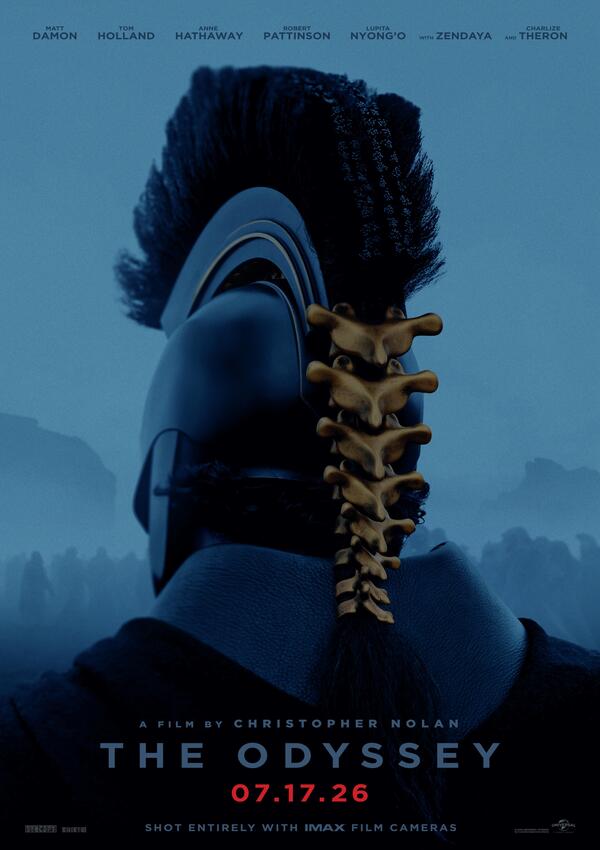
- Director/Screenplay: Christopher Nolan
- Cast: Matt Damon, Tom Holland, Anne Hathaway, Robert Pattinson, Lupita Nyong’o, Charlize Theron, and others
- Studio: UNIVERSAL PICTURES
- Original Work: Homer’s Odyssey
Narrative and Structure
Homer’s epic poem Odyssey covers the vast 10-year journey of Odysseus (played by Matt Damon) from the immediate aftermath of the Trojan War until his return to his hometown, Ithaca. It maximizes the dramatic effect of the story by utilizing In medias res (starting from the middle of the action) and a frame narrative (present-past-present configuration). The story begins with the tale of Odysseus’s son, Telemachus (played by Tom Holland), before returning to Odysseus. After Odysseus’s narrative has progressed for a significant duration, it describes the events following the Trojan War by recounting the past. As it is a story with an inherently non-linear structure, Christopher Nolan’s scene composition and plots utilizing time are expected to shine.
The Portrayal of Gods and Realism
Clues regarding how the stories of the gods will be unfolded can be found in the director’s interviews. In an interview with Empire, he stated, “By embracing the physical aspects of the real world in the filmmaking process, you can add interesting information to the way the story is told,” which suggests the possibility that the roles of the gods may have been translated into natural phenomena rather than supernatural beings. The effort to capture dynamism by actually filming at sea for four months leads to the guess that Odysseus’s journey will be expressed through the physical hardships of the ocean.
Visual Aesthetic and IMAX
Christopher Nolan has previously captured the harshness of nature on screen through Dunkirk and implemented overwhelming yet aesthetic mise-en-scène through Inception. His emphasis on IMAX filming can also be interpreted in this context. It suggests a depiction of an individual’s fragility when overwhelmed by nature, as well as the courage and struggle to overcome it.
Official Trailer from Universal Pictures
Scope and Concerns
One concern stems from the director’s remark, “I put everything in,” and the appearance of the Trojan Horse in the trailer, which suggests he might have truly attempted to capture the entirety of Homer’s epic. Realistically, adapting the vast epic of 24 books into a single movie does not seem easy. Even if the stories of the gods were integrated into nature, a long running time seems inevitable given that the number of rugged islands Odysseus visits is not small.
Conclusion
Odyssey appears to be the optimal choice for demonstrating Christopher Nolan’s strengths in imagination and organizational ability. However, there is also concern regarding whether the political narratives or conclusions shown in Dunkirk and Oppenheimer might be repeated. Nevertheless, the expectation that it will provide a visual spectacle and an overwhelming experience for the audience is greater. August seems far away, but retracing his previous works while waiting might be one way to pass the time.