The news that Director Jang Joon-hwan’s Korean film Save the Green Planet! would be remade inspired more anticipation than concern. It was expected to be a rational alternative that could correct the crude direction—which prevented the audience from fully grasping a solid plot—and expand the original charm to a broader public.
However, the released Bugonia by Lanthimos completely betrayed audiences who expected an evolution of the original. While delivering a thematic core entirely different from the original upon the same plot, Lanthimos’s sharpness instead tore the original script to shreds. Throughout the film, I found myself longing for that crude direction. Lanthimos has sharpened Jang Joon-hwan’s hammer so finely that it can no longer even shatter glass. Had I watched it without knowledge of the original, it might have ended in mere disappointment with Lanthimos; however, from the perspective of a viewer who expected the vitality of the original, it served as confirmation that Lanthimos, too, is a part of Hollywood. This is a trap of the remake and a systemic limitation, but it also reveals where Hollywood and Lanthimos’s recent films are focusing their attention.
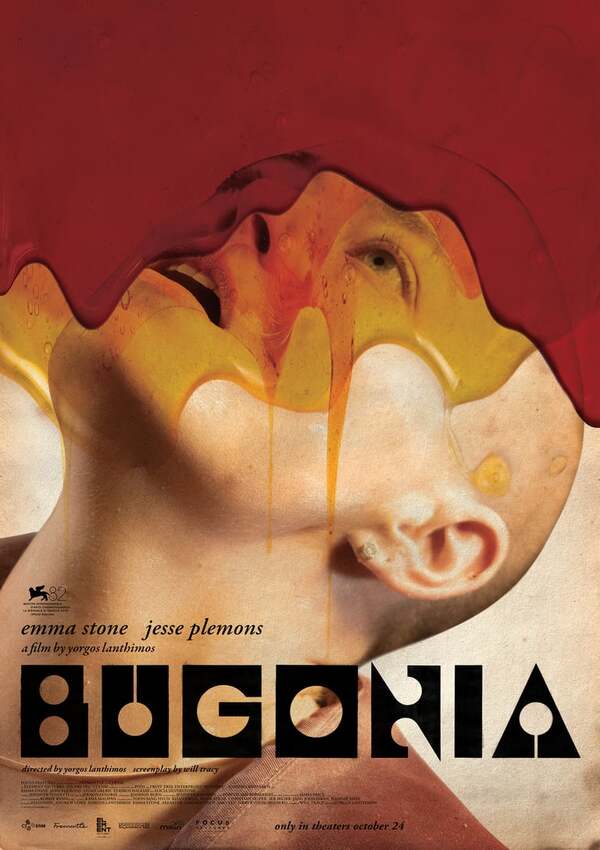
I shall conduct an anatomy of both works to observe how the visceral experience of the original hammer was coldly exhibited through Lanthimos’s refinement. The following dissection necessitates the full exposure of the narrative’s terminal points.
A Heavy Plot Tearing Through a Light Shell
Save the Green Planet! demonstrated that a confusion of identity can become a fatal weakness of the work itself, beyond a mere marketing failure. This film, still classified as a comedy by the Korean Film Council, received a report card of box office failure by throwing incoherent slapstick and a discordant ending at an audience expecting genre play. However, the reason this film was re-evaluated is that an exquisite plot, which Hollywood would covet, is hidden beneath its childish shell.
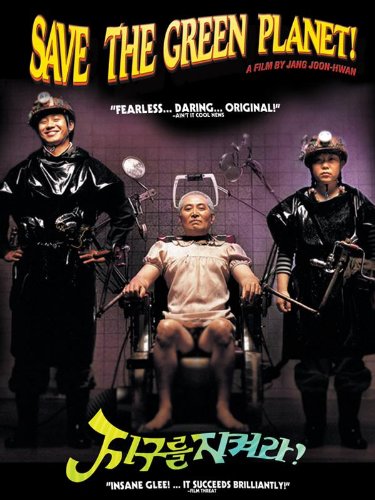
The confrontation between Byeong-gu and Kang is not a simple kidnapping drama, but a desperate struggle of class reversal between a victim and a perpetrator of socio-structural violence. The film uses Byeong-gu’s madness to provide the pleasure of subverting social classes, yet causes betrayal and confusion in the audience through a twist that makes it feel like a personal revenge. However, the secondary twist of the ending—revealing that Kang was indeed an alien—grants legitimacy to the resentment of the socially weak, which is often dismissed as delusion. This goes beyond a simple twist to provide a catharsis that destroys the reality where structural subversion is impossible.
Jang Joon-hwan’s blunt direction reinforces these themes. The exaggerated expressions and unrefined mise-en-scène reveal someone’s resentment while simultaneously showing the dizzying state before an explosion. The crudeness of the direction could be seen as intentional, but it ultimately became a self-defeating move that hindered the work.
The problem was that this bluntness was concentrated on comedy. Excessively prominent comedy interferes with the audience’s immersion and damages the essence of the film. The moment comedic play becomes the objective, Byeong-gu is reduced to a bizarre laughingstock rather than a symbolic actor. Ultimately, a heavy theme was placed in the light vessel of comedy, and once the vessel broke, the theme became unrecognizable.
A failure in pacing also hindered immersion. The kidnapping process evaporated into comedy, and the confrontation process dragged on tediously. Before the urgency of the latter half could take effect, the audience was already exhausted. Throughout the viewing, it made one think that it could become an undeniable masterpiece if proper pacing and restrained comedy were added.
The word remake leads one to expect that the highly-regarded parts of the original will be preserved and the under-evaluated parts will be compensated. However, Lanthimos changed even the theme of the movie. Lanthimos’s Earth was not the place Byeong-gu protected and Kang blew up.
The Resentment of the Weak Taxidermied by Lanthimos’s Sharpness
Lanthimos succeeded in exquisitely tailoring the pacing and genre consistency of Save the Green Planet!. In particular, his aesthetic sense was evident in the use of specific colors for the mise-en-scène of each sequence. However, resentment evaporated due to that precision. The fixed angles and the gaze reflecting the side or back of the characters thoroughly externalize the audience and the characters. The experience of sharing in Byeong-gu’s resentment disappears, and one comes to view Teddy’s bizarreness from a safe distance. This distancing is a method that has been repeated in Lanthimos’s films, but the problem is that the gaze is directed toward social subjects or classes rather than psychological or ethical issues. The socially ruled became taxidermied butterfly specimens in a display case rather than subjects of action.
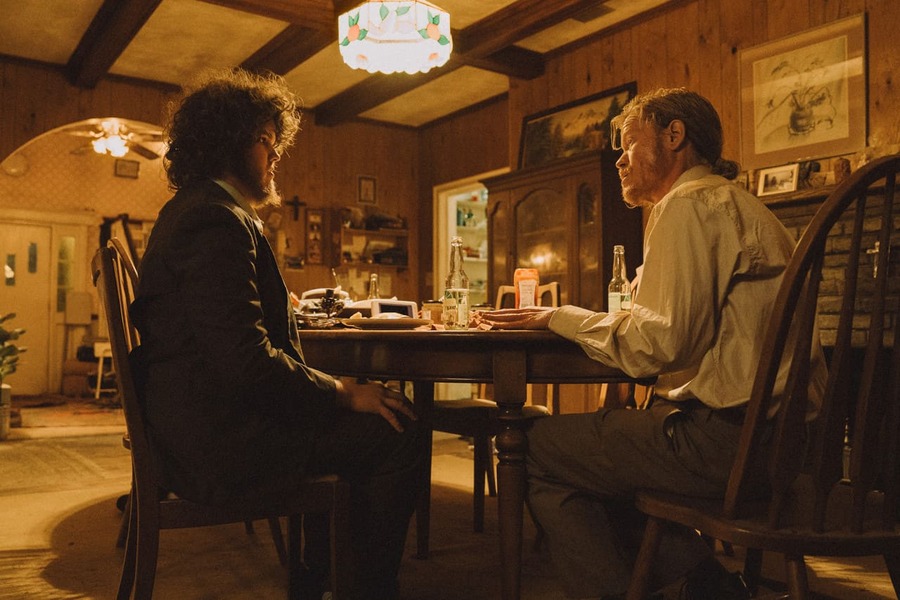
This change is specifically revealed through the fundamental differences in characters. In the original, Byeong-gu explains the plan to his assistant Su-ni and shares the truth. She was not a subject requiring persuasion. The same applies to Kang. Rather, Kang struggles to persuade or incite Byeong-gu and Su-ni. However, Teddy in Bugonia is different. He constantly struggles to persuade Don and Michelle. Ultimately, the persuasion fails, and Don takes his own life. The sacrifice of an innocent life turns Teddy into a villain of conviction who self-destructs in his own foolishness. Byeong-gu’s explanation implies a state where the legitimacy of resentment is already shared. However, Teddy’s persuasion defines him as a target requiring isolation, as one who contaminates others.
The change in setting is even more cruel. In the original, Byeong-gu’s mother does not die from his benzene. However, Teddy’s mother dies because of Teddy, who was deceived by Michelle. Blind faith causes the destruction of precious people around him, leading him to be condemned as an ignorant disruptive element in society. Even the direction of his death by his own bomb at the conclusion puts a period on the ridicule directed at the protagonist.
The scene of Kang’s confession, which was the highlight of the original, is replaced by the most baffling void in Bugonia. In this scene, Jang Joon-hwan maintains a high-tension pace and grants logical probability to Byeong-gu’s flimsy delusion, inducing the audience to doubt the existence of truth. Conversely, Lanthimos treats Michelle’s confession too briefly and abruptly, resulting in the effect of the audience becoming certain of the delusion.
This consistency of ridicule collapses the causality of the ending. The moment the reality of the alien is revealed, the delusion Teddy has built up loses its place. Although the conclusion of the Earth’s explosion is replaced by the death of the Earthlings, this castrated the catharsis of the original, and the artificial metaphor resulted in obscurity. The conclusion of the original could not settle in Bugonia, where the theme had changed, and the forced fitting covered an empty box with wrapping paper. Numerous interpretations stem from the desperate attempt to prove what, in fact, does not exist. There is no way an appropriate image exists in a forcibly assembled montage. Nevertheless, the result of the effort finds a common denominator in making Teddy an object of observation. This is also a result of Lanthimos’s early psychological expressions yielding to the act of interpretation to satisfy Hollywood’s intellectual vanity.
Jang Joon-hwan’s Hammer Was Needed to Rescue the Taxidermied Resentment
It has become a trend for Hollywood to focus on films to be interpreted. Appreciation has become another word for interpretation, and taxidermy has become the grammar of film. The problem was the target of this taxidermy. If the ruling class or the establishment of society had been taxidermied and ridiculed, it would not have been this unpleasant. However, if a group comforted by Jang Joon-hwan must be ridiculed by Lanthimos, one cannot help but read that Lanthimos induced this unpleasantness. Perhaps if Bugonia had no original work, it would have stopped at aesthetic unpleasantness regarding externalization. However, the fact that the subject was Byeong-gu is a rebuke intoxicated by aesthetic superiority and a betrayal of the original’s comfort.
The risk of the remake lies here. I remember being disappointed when watching the remake of The Housemaid in the past, as the multi-dimensional imagery and cinematic achievements were replaced by the visualization of social class structures. The creativity of the writer or director is limited by the original, and the appreciation of the original affects the remake. Lanthimos and Will Tracy are professionals who have shown high creativity. However, if their creativity is limited and misused in a direction that damages the original, it cannot be a good result for either the films or their fans.
The regret felt after watching Bugonia became the driving force to watch Save the Green Planet! again. I even came to miss his crude direction and exaggerated expressions. If past films viewed the venting of the resentment of the socially ruled as an achievement, modern films use the criteria of how aesthetically they are displayed and how much room for interpretation is granted. Now, Hollywood gives higher marks to elegantly decorated theses than to scripts felt with the whole body. This treats the target of film viewing not as the common citizen, but as the establishment, especially the layer in need of intellectual vanity. It is true that film is an element of entertainment. However, if that entertainment is limited to a treasure hunt for Easter eggs and the cinephile is interpreted as a person seeking the correct answer, films that once gave shock and thrills will no longer appear.
Note: All movie posters and stills used in this analysis are the property of their respective copyright owners and are used here under Fair Use for critical review and educational purposes.