Fashion is one of the body language. It is conveying something by itself, and individuals reveal themselves through clothing. In movies, costume, as one of mise-en-scène, performs the functions that fashion has as they are. It creates imagery to the audience and reveals the character’s personality. A representative example utilizing such expression is Breakfast at Tiffany’s. The dress of Audrey Hepburn designed by Hubert de Givenchy well shows the charming impression the character has. Also, a feeling of showing the ideal of Holly Golightly (played by Audrey Hepburn), symbolized by the jewelry store, is felt. The appearance of standing on the roadside looking into the jewelry store while holding coffee, bread, and their wrappers forms a contrast with her costume, well showing the gap between the character’s life and ideal. Costumes in The Devil Wears Prada perform additional roles besides showing the character’s personality and situation as they are. As the character arc progresses, it shows the point of change or makes the audience visually perceive the changes in surrounding circumstances accordingly. Also, it performs the function of providing visual pleasure and assisting the lighthearted, entertaining elements that the movie has. Fashion is a main subject matter of the movie, but it is also operating as a part of the major mise-en-scène constituting the movie. However, because the movie’s narrative and characters are not three-dimensional, the metaphors given by the costumes correspond one-to-one and are functioning intuitively. I intend to analyze how the costumes of this movie are being utilized as a tool of expression, focusing on structural functions rather than their referents of metaphor.
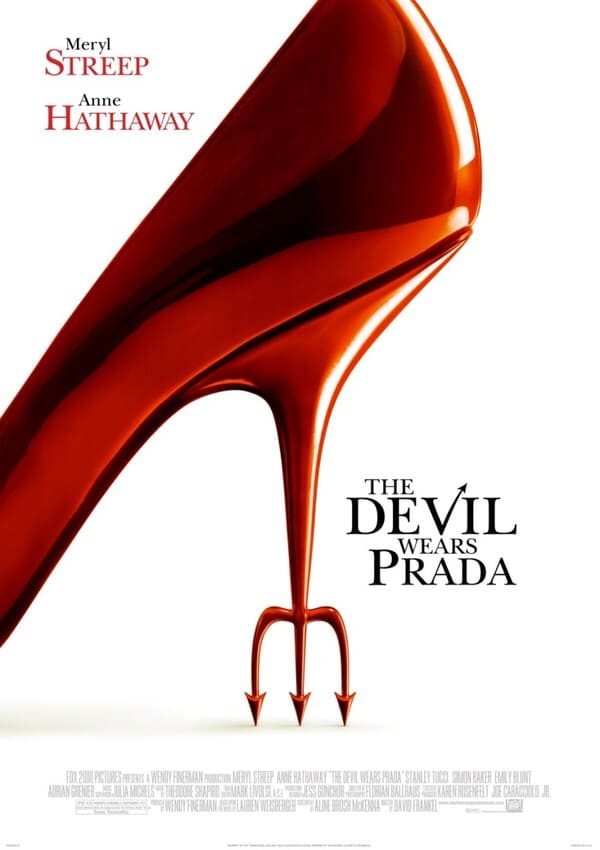
Note: The following analysis necessitates a full discussion of plot points and the film’s conclusion to effectively examine its structural achievements.
Visual Shorthand: Bridging Narrative Gaps Through Costume
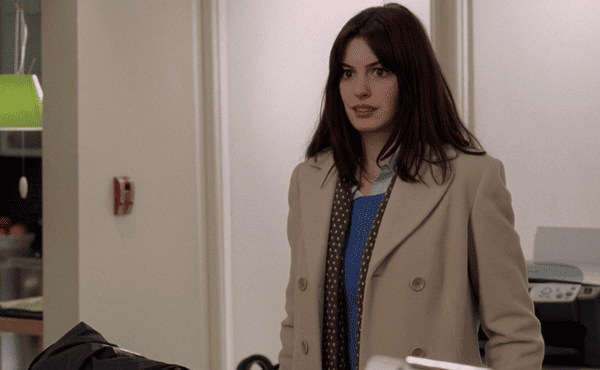
This movie depicts the classic dilemma between a professional woman’s ambition and private life by pitting social success against domestic conflict. Due to a narrative close to a cliché, the character arc also contains a relatively simple structure. The narrative—integrating with another group to reach an ideal and finding a social role and identity—reveals the metaphors that each subject is in charge of without hesitation and leads the audience to the desired place. In that process, costume performs the role of revealing this intuitively. Starting from the ideal of Andy (played by Anne Hathaway), who is a recent entrant into the workforce, has as a pragmatic social member, the process of returning to her roots as a journalist after assimilating into the fashion world is effectively revealed through changes in costume. Such economy sometimes performs the role of reinforcing the one-dimensionality of the narrative, but it also performs the role of filling the gaps in a compressed and narrative leaps. The process of changing the perspective on the fashion world and the profession within it through Nigel’s (played by Stanley Tucci) advice progresses somewhat leapingly in that it accepts the industry and professional values with a single word. However, it utilizes a visual shorthand called costume so that the audience can easily accept this. By showing a sequence in which sophisticated luxury costumes change continuously, it visually reveals the process in which she performs work for a long period and comes to accept that profession. This grants room to accept that leaping development while the audience intuitively perceives the process of the character changing even without long explanations. This montage also grants visual pleasure. By showing how the actress Anne Hathaway and the character Andy she plays accept and pull off numerous luxury costumes, it makes the audience see a fashion show that makes the road a runway. Such a playful device becomes an effective means of momentarily liberating the audience from the monotony given by the narrative and making them immerse in the movie.
Mapping Relationships: Sartorial Harmony and Contrast
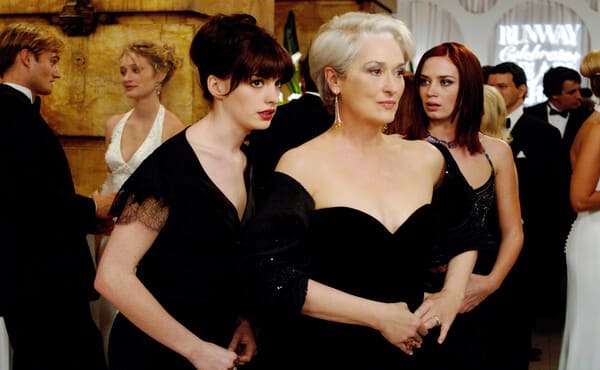
Relationships with surrounding characters are also revealed through costumes. Due to the simplicity of the narrative and characters, it is not difficult to understand those relationships, but by utilizing visual devices, it gives the audience the feeling of being provided with three-dimensional imagery. It makes the audience effectively perceive the relationships between characters through the homogeneity or heterogeneity between costumes or between costumes and places. When Andy shares the same worldview as her boyfriend, this was confirmed through the homogeneity of costumes, but when her costumes approached Runway, it gives the audience a sense of heterogeneity with her boyfriend’s costumes, allowing them to notice the gap in the relationship. The living space shared by the two also aesthetically parallels the formal structure of the costumes of Nate (played by Adrian Grenier), operating as a background that highlights the process of Andy transforming into a heterogeneous being. Similar to the character arc, this also functions as a device that makes the audience accept the narrative leaps. Even if the trigger for the accumulation of conflict with the boyfriend is indistinct, because that conflict has been visually accumulated, the audience becomes able to reduce their resistance to it. The relationship with Miranda (played by Meryl Streep) also makes the audience accept the process of the relationship becoming closer by visually perceiving the relationship through the similarity of costumes as a member of that world. Conversely, in the process of Miranda informing Andy of the divorce, the robe she was wearing shows a defenseless state where the social exterior has been removed, informing the audience that they are seeing her inner self or authentic appearance. Andy’s luxury costumes function as a social role, and through that contrast, they make the audience more clearly perceive that they are approaching Miranda’s private life.
If the simple narrative and character arc had been revealed through long-winded of dialogue or reductive emotional expressions, it would have been difficult to secure the mass-market appeal that numerous audiences can choose. It is a fact that multi-faceted expressions are lacking to feel a special charm in the conflict patterns or the conclusion of the movie. Nevertheless, the movie added the fun of watching the movie by actively utilizing the characteristics of the subject matter. By expressing visually instead of explaining, and revealing these expressions in a form that includes viewing pleasure, it gives the audience an opportunity to escape from the monotony of the narrative. The upcoming sequel arriving after a long hiatus makes the audience curious not only about the expansion of narrative and characters but also how these expression methods will function in this new entry. After the release of The Devil Wears Prada 2, I plan to check and analyze whether it will present new structural devices suitable for the expansion of the narrative or replicate the grammar of the previous work.
Note: All movie posters and stills used in this analysis are the property of their respective copyright owners and are used here under Fair Use for critical review and educational purposes.
From Structure to Sequel: Read Our Preview of The Devil Wears Prada 2 Here.