The movie Michael is ahead of its release. As a symbol of the era and a pioneer of popular art, his life story coming out as a movie is a natural progression. His turbulent life makes expect a dramatic narrative. Like this, biographical films dealing with a musician’s life are appearing one after another. Considering that music is an essential element of film, it is a quite attractive subject in that it can be organized in a jukebox format. Adding a narrative to music that has already moved many people becomes a means to present another emotion. Nevertheless, when talking about jukebox biographical films, Bohemian Rhapsody still comes to mind.
The first thing I felt after watching this movie was a sensory experience. Although it deals with a person who existed, while watching the movie, I was not paying attention to the fact that the person is a real person. Breaking away from the constraints of historical facts, the emotional experience provided by the narrative and the existence of music that strengthens it were drawing immersing into the world of the film. This movie is not a documentary. It is not a movie that presents philosophical discourse either. It is closer to a product of deep consideration what to show the audience and how to make them feel. Nevertheless, this movie is showing an aspect where the evaluations of critics and the evaluations of audiences are sharply divided. Movies exist for the viewing of the audience. There is only a difference in the tools and methods used to facilitate that experience. Centering on these criteria, I look at the expression methods and the originality of this movie from a different perspective than existing criticism.
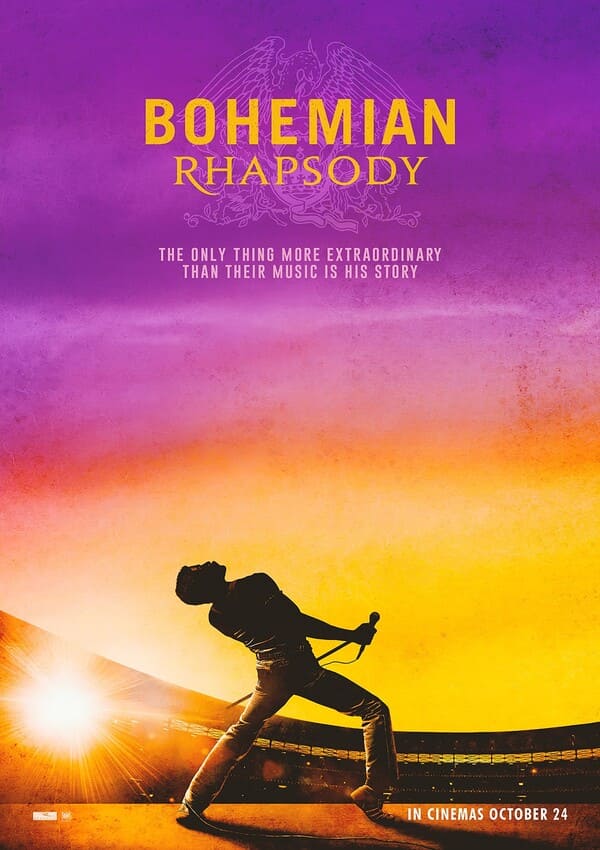
Note: The following analysis necessitates a full discussion of plot points and the film’s conclusion to effectively examine its structural achievements.
Visceral Narrative: Conveying Emotional Complexity via Intuition
Films utilize the unique characteristics of the medium to provide audiences with different viewing methods. If a certain movie allowed audiences to feel something through a complex and three-dimensional narrative, this movie aimed to maximize that experience with direction utilizing sensory elements while the audience follows the narrative. The critical standard should be aligned not with the complexity of the narrative, but with how effectively the form induced the audience’s appreciation. Freddie Mercury in the film is a character depicted uniquely and intensely. His life is also not ordinary. Nevertheless, the reason audiences can be immersed in and empathize with him is because it secured universality by making the narrative easy to accept. Also, the types of emotions the character experiences are not common or flat. The highlight of those emotions is the relationship with Mary Austin. He loves her, but he cannot love her. Expressing such emotions in words is impossible. It is difficult to express these emotions through any label, be it “human relationships,” “friendship,” or any other expression imaginable. What shows this best is the lighting scene across the window. Just because a relationship is severed does not mean the emotional bond is also broken. It was especially so for Freddie Mercury. The situation where, when he turned on the light, she would respond with the light of her room across the window, was a hope like light thinly shining through thick fog. The despair of not being able to catch that light gave the impulse to flee the situation. The light riddled with parties and entertainment that he sought in order to flee was flashy but empty. Gradually, he blinded his own eyes with that flashy light, and after going blind, only darkness existed. After Austin came to meet another person to live her own life, no matter how much he turned the light on and off, even the thread-like light across the window was not visible. His agony and worry originated not from confusion about sexual identity itself, but from the separation from his only love, which was the cost of embracing his identity. What he wanted to flee was not sexual orientation, but the loneliness of having lost the object to love. The movie showed through direction how lonely it is to become unable to love the only love one knows, and how frustrating it is to be unable to resent anyone. Interpreting the existence of Mary Austin as a heteronormative sanctuary is a result of turning away from the substance of emotions built up by the direction. This is an example showing how attempts to judge similar settings with a single yardstick misread the essence of the film.
The Architecture of Tension: Driving Conflict Through Contrast
Direction that crosses contrasting situations makes these emotions feel more dramatically. In the scene where he confesses the situation of loving Mary Austin but being unable to love her, a performance video where the audience sings “Love of My Life,” a song for her, together forms a contrast. By crossing the response of numerous audience members and the beginning of isolation, and contrasting the beautiful song and the love its recipient cannot receive, it amplifies the emotional chasm. Like that, in the place where she left, Paul Prenter, who intends to use him, takes a place. He designed an escape pathway of provocative and empty pleasure in the place where the light disappeared. At its end, there was an abyss that drives Freddie Mercury into deeper isolation. The movie intensifies the conflict and the tension resulting from it through such contrasts. Starting with small conflicts and pleasures at first, as cinematic achievement grows, that achievement and conflict show a larger difference. Because of this, Freddie Mercury’s character arc loses its way and the audience comes to feel anxiety and tension. In that [it] induces tension through narrative, [I] strongly get the feeling that it is indeed a Bryan Singer movie. The method of building suspense throughout the drama using the character’s anxiety as a driving force is one of Bryan Singer’s characteristics. Through the severance of relationships, isolation, and the conflict resulting from it that support the entire narrative of this movie, the audience feels tension and that tension induces immersion. Whether it is because most of the core production staff, including the editor, were maintained until the end, consequently, despite the change of director, Bryan Singer’s signature is strongly felt.

Sensation Over Cognition: Directorial Choices for an Experiential Cinema
Fast narrative helps the audience choose sensation over understanding. In this movie, the audience must experience music, must accept unusual emotions as if familiar, and the movie must induce tension through the character arc. If the audience comes to reason through their own experience, it damages the emotional purity in the process of being conveyed the unique emotions the movie possesses. The individual experiences and emotions of the audience become noise in the act of appreciating the movie. For sensory projection that precedes analytical understanding, the movie chose fast development. The movie put sensory scenes at the forefront rather than narrative plausibility, and induced tension through fast cut-editing rather than static direction. This kind of fast cut-editing is showing the tension well when an arrogant artist met capital. While quickly crossing tight shots of characters, it allows the audience to simultaneously feel and grasp the emotions and interests each of all characters has during the conversation process. The movie directly struke the audience’s retinas with their expressions and postures and utilized even those afterimages for the direction. These momentary emotions of characters formed on the retina like this fill the gaps between fast cuts and pile up layer by layer in the audience’s subconscious. If the movie intended to express this through long takes, it would have been difficult to make the audience come into the drama and experience and feel it by granting an observer’s perspective to the audience. In the sense that editing and direction acted as an aspect that helps the audience’s viewing, it is difficult to find great meaning in the point that it was an inevitable choice due to the change of director. It is also difficult to agree with the opinion that fast cut-editing interferes with the accumulation of emotion within a cut. The movie accumulates emotions throughout the entire narrative and bursts them through scenes. It is composed not as a movie where the audience feels everything through a single scene, but as a movie where they feel the flow while viewing along the entire movie. Even in terms of music, fast narrative was effective. If the movie had chosen a slow narrative, it would have functioned in a direction that damages the musical liveliness of rock and roll. The explosive power that sensory beats and bass lines possess met with fast and intuitive narrative and exerted synergy.
The Biopic of a Song: Prioritizing the Music Over the Man
The reason this movie was made as a movie for experiencing is certain. The movie set its goal on sensorially accepting Queen’s music. Therefore, rather than an obsessive dissection of real people and events, the movie placed priority on a cinematic reimagining that can maximize the emotional waves of the music. At the end of the emotions the movie conveys, there was always Queen’s song. While the movie is progressing, all of Queen’s songs are respectively stimulating the audience’s senses. In this sense, the direction that made the development of narrative and the accumulation of emotion synchronize exquisitely with their music is a core achievement that materializes the sensory experience the movie pursues. Emotions accumulated throughout the movie explode at the final Live Aid. Even if the audience does not shake the fence and shout, they are granted overwhelming sensations while being with their music. In this aspect, it is difficult to find meaning in the criticism that the movie consumptively utilized surrounding characters and his illness. These devices function to convey the vitality their music possesses to the audience in the performance scene at the conclusion. In order to convey the resonance inside the heart that their music gave through the movie, the movie used devices the medium possesses. This movie is not a biographical film of Freddie Mercury. It is a biographical film about Queen’s songs. While the credits roll after this movie ends, what remains in the audience’s heart is not Freddie Mercury’s tragic life, but the infinite resonance given by Queen’s songs.

Performer vs. Protester: Reclaiming Freddie’s Human Identity
Criticisms that the movie directs sexual orientation negatively are also seen. Critics seem to perceive that the timing of Freddie Mercury’s deviation and the timing of his realizing his sexual orientation are identical. However, there is a difference in timing between these two. The timing when Freddie Mercury realized his sexual orientation was in the process of his relationship with Austin reaching its peak. The realization of orientation and the character’s facial acting were implying that the relationship would end. Deep layers of emotion of being unable to love a loved one continue, making the role of this setting clear. His wandering begins after that, due to external abuse and exploitation. This is pain as a human, not debauchery due to sexual identity. His orientation is just an orientation; it does not symbolize anything. He exists not as a “protester,” but as a human and a performer. The idea that every movie contains metaphors and carries a political or social message is an act of consuming the pure emotion of a work to satisfy intellectual vanity. They are more preoccupied with checking the answer sheet of the ideology they projected than with the substance of the emotions built up by the movie. The appearance of Jim Hutton at the point where external exploitation begins to progress makes it clear that sexual orientation is not a tool for deviation but a lifestyle. In the sense that he values emotional exchange rather than physical relationships, he suggests a direction of daily life rather than another stimulation. He is the archetype of the daily life that Freddie Mercury must finally reach, and the only ray of hope that will lead him to that path.
There are many musical films, and there are many biographical films. There were some attempts to combine these two. However, the reason this movie was chosen by the public is that they could see and feel the music. This movie gives the impression of listening to a six-minute track despite its running time. High-density emotion makes the audience immersed, and the sensory experience of music maximized the emotion. His death did not mean his ruin, but showed his achievement that remains forever. His hardships and adversities, rather than making him a hero, made the audience feel our situation of receiving healing through music amidst numerous difficulties. Numerous emotions that we felt through music in daily life induce emotional bonds within the intuitive narrative. This work is, I think, an example that suggested another direction for what kind of achievement film can show. It is difficult to gauge what kind of movie the soon-to-be-released Michael will show. This is also because biographical films of musicians that appeared after Bohemian Rhapsody did not show a performed very well. I intend to watch with interest whether it secured emotional depth like those shown by this movie, and whether it utilized the movie theater as a space for musical experience rather than a mere place for viewing.
Note: All movie posters and stills used in this analysis are the property of their respective copyright owners and are used here under Fair Use for critical review and educational purposes.