Among the numerous masterpieces we know, there are not a few movies based on other types of works. Looking at evaluations of these movies, stories about fidelity seem to arise more often when they receive poor reviews rather than generally good ones. Judging from this, the original work is merely a baseline for expectations, and the screenplay ultimately lies in cinematic achievement. I wish to call the process of composition itself, which reconstructs the original as a cinematic tool to enable a multidimensional experience, “cinematic adaptation.” Considering this, among works that have not yet been produced as films or have been produced but failed to deliver results, several works come to mind as being suitable for screenwriting. By selecting works with excellent structural potential that have yet to achieve cinematic results, I intend to propose a creative challenge to screenwriters.
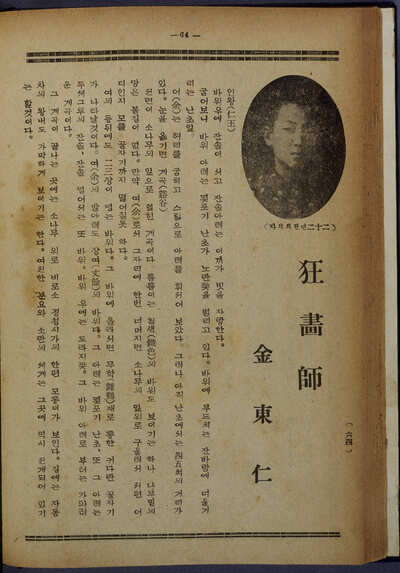
Source: Gwanghwasa by Kim Dong-in,
Encyclopedia of Korean Culture
(한국민족문화대백과사전).
License: KOGL (Korea Open Government License)
The first work is Kim Dong-in’s modern Korean novel Gwanghwasa, published in 1935. This work, with a title that can be interpreted as roughly “The Mad Painter,” is set in Joseon, but it possesses elements that can be utilized not only for modernization but also as a motif. The setup of this work has room to cause discomfort or appear as a cliché from a modern perspective. Settings that were tolerated because they were past works, such as physical defects and the objectification of women, can become problematic in modern times. However, because similarity in setup does not imply similarity in expression and content, this novel remains valid. Physical disability does not merely end with inducing isolation from others; it functions as a narrative device that can be used creatively in that it leads to an exploration of the inner self. The perspective of viewing women as objects is the same. The woman in the novel does not exist as a sexual object. It is an element that transitions from a human as an individual exploring their own inner self to a human formed through relationships with others. Even without relying on the outer shell of gender, the function provided by the role remains the same. If numerous existing clichés have been born as masterpieces under the creativity of screenwriters and directors, the following content proves to be sufficient to exhibit even greater creativity. To examine this, let us slowly look at this novel starting from the plot.
The Narrative Framework: A Blueprint of Madness
This work begins with the imagination of a certain novelist. A novelist, who climbed a mountain and was deeply moved by its scenery, creates a painter with an ugly appearance. Because of that ugly appearance, women run away, and even when he walks through the town, he goes around covering his face. Living like that for over 40 years while suppressing his lust alone, he learned to paint and has been drawing landscape paintings. In the midst of that, he gradually developed a desire to paint a portrait of a beautiful woman. He wanted to paint a beautiful and kind face like his mother’s. One day, he discovers a blind woman aged eighteen or nineteen. In the eyes of her, who wanders around seeking the beauty of the mountain that she cannot see, the painter thinks that he has found the subject for his painting. When he spoke to her, that beauty temporarily disappeared from her eyes, but upon hearing the story of the Dragon Palace told to lure her, they returned to their original state. Drawing her beautiful face in his hut like that, it grew dark, and he left only the pupils unfinished. Postponing the completion until the next day, he approaches her and spends the night with her. On the next day when he intended to complete the pupils, her eyes were not the eyes of yesterday. They had changed into the eyes of a woman longing for love. While demanding that she recall yesterday’s imagination, when her gaze did not return, he poured out insulting words and reached the point of killing her. Her falling body struck the inkstone, and the ink from the inkstone drew the pupils on her portrait. The eyes of her completed in that way were the eyes of resentment shown while dying. Eventually, he wanders around holding her portrait, becomes an old madman, and dies away from home.
Narrative Distancing: The Controllable Dynamics of Madness
In Korea, the meaning of this novel is seen as a reflection on aestheticism or art-for-art’s-sake. It is understood as a work that asks the question of whether it is justifiable to abandon human ethics for the sake of art. Such interpretation seems to find connection points with his other works, especially Gwangyeom Sonata. However, I believe that behind these interpretations lies an exploration of human nature on a deeper layer.
Human survival is essentially directly linked to possession. How much one possesses is also used as a measure of how much one can survive. Therefore, the desire for possession is close to a fundamental need for human survival. The problem is that as the gap between the desire for possession and actual possession becomes larger or longer, that gap gradually becomes a wound and widens. This literary work illustrated this gap through obsession and expanded it into madness.
The reason I believe this novel can be turned into a screenplay also starts from here. Works that explore the human inner self do not need to be limited by time. Both the novelist and the painter appearing in the work could be modern figures. This is because possessiveness and obsession remain valid for modern humans as well.
The fact that it leaves interpretation open and can be appreciated through imagery is also a reason for choosing this novel. It begins with the process of a certain modern novelist creating a story through a fictional character from the Middle Ages. This serves to isolate the subject from the object. Although it is a story that imparts dynamic imagery, one can appreciate the object as an isolated subject. This provides room for distancing oneself as an observer even without using refined expressions. The novel expressed this as a narrative, but film possesses various devices to express this. It aligns with the structures of recently popular films, such as the distance from characters, the fixity of angles, and scenes illuminating the side or back of a character.
Even without necessarily substituting the narrative with scenes, the role of the novelist has aspects to be utilized. While the novelist is continuing his imagination, he is interrupted by the noise of outsiders. He reveals his discomfort in the process of climbing up and coming back down the mountain to avoid such interruptions. This kind of negative perception regarding external figures has a side that touches upon the perception the painter has regarding others. The painter within the novelist’s imagination feels jealousy regarding love and relationships that he does not possess. He belittles the romances of others and their partners, and such thoughts lead to an obsession with the portrait of a beautiful woman. Driven by his own possessiveness, he denies the possessions of others and gradually isolates himself. Ultimately, it means that the othered target has similarities with himself. This can provide room for the audience to project the observed object onto their own story and penetrate into their own realm of appreciation.
Setup for Open Interpretation: Components Beyond Fixed Metaphors
The power of the work also lies in leaving room for interpretation without obsessing over metaphors. The painter’s forcibly suppressed lust and the resulting obsession, the physical disability of the beautiful woman, and the tool of painting that connects these two act centrally in the narrative plausibility and naturally penetrate the audience’s appreciation. This helps the setup not obsess over any one interpretation and allows each person to unravel it in their own realm.
The expressions regarding beauty are the same. The eyes with which his mother looked at him are expressed with words interpreted as desperate longing or kind expressions. The beautiful eyes that the blind woman possessed are revealed by curiosity about unseen nature and the imaginary Dragon Palace. However, the eyes shown when talking to someone in reality or feeling emotions of love for him are beautiful, but they are not what the painter wants. This enables one to see the beauty possessed by an isolated subject who cannot feel [beauty] in relationships with others. It presents something differentiated from the human beauty commonly spoken of until now. This conveys a special imagery that becomes a leap if one tries to interpret something specific. Personally, I think if the actress playing the blind woman is not a typical beauty type, it might even penetrate more deeply into the painter’s obsession. Including this, there are many challenging voids in this novel that creators must fill.

Image generated by AI (Google Gemini)
Visual Imagery: The Foundation of Imagination for Mise-en-scène
Natural scenery and dynamic expressions also construct mise-en-scène that stimulates visual inspiration. The cabin in the mountains where the painter lives shows his isolated life as it is and can impart a mysterious texture that allows for the perception of a fictional situation. Such sensations can be implemented in-depth in the scene of the meeting with the blind woman. The scene of seeing beauty in her eyes and the image of approaching her without even thinking of covering his own face because of it blend naturally with the mysterious natural scenery. How to visualize the moment when the beauty he desired disappears from her eyes and reappears shortly after also gives the director room to exercise imagination. Also, the scene of luring her and taking her to the cabin, or finally murdering her, induces tension and creates discomfort, leaving a strong emotional afterimage on the audience. The process of painting until it becomes dark and he can no longer paint makes one imagine what kind of dynamic relationship the dark surroundings and the lighting will show. The final ending where he goes mad, wanders around clutching the portrait, and dies allows for various situational directions, enabling the effective projection of the aesthetic result the writer desires and leaving sufficient room for reconstruction through imagination.
Even if the setting changes and the era changes, the bizarre multidimensionality that this novel narrates remains valid. Through stories that do not exist in reality, we can look into our inner emotions. I believe that showing this visually and making it felt multidimensionally is the essential achievement that the medium of film must reach. In this respect, Gwanghwasa possesses the power to exert a significant influence on a screenplay, even without being transferred exactly as it is.